
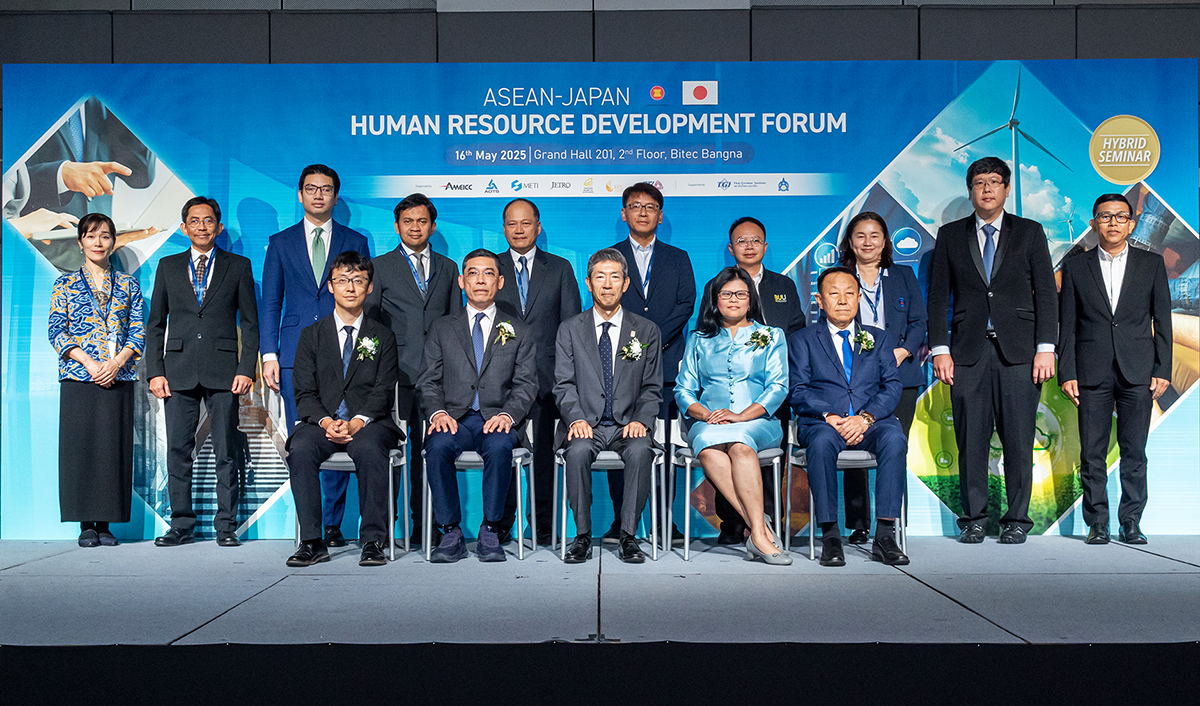
The environment surrounding the ASEAN supply chain is currently undergoing a major transformation. To address carbon reduction (GX), digital transformation (DX), and the rising geopolitical risks, human resource development and collaboration between industry, government, and academia across the region are essential.
ASEAN-JAPAN Human Resource Development Forum convened in Bangkok on May 16, 2025. This event represented a collaborative undertaking among AMEICC and AOTS, the Japan External Trade Organization (JETRO), the Board of Investment of Thailand (BOI), the Eastern Economic Corridor Office of Thailand (EECO), and the Federation of Thai Industries (FTI).
The forum was attended by representatives from companies and universities across ASEAN countries, as well as government agencies from both Japan and Thailand. During the event, discussions were held on the development of human resources to drive industrial development through Lean Manufacturing, Digital Transformation (DX), and Green Transformation (GX), along with concrete measures and the latest approaches to implement these outcomes in real-world settings.
* For the full press release on the "ASEAN-JAPAN Human Resource Development Forum", Click Here (Japanese)
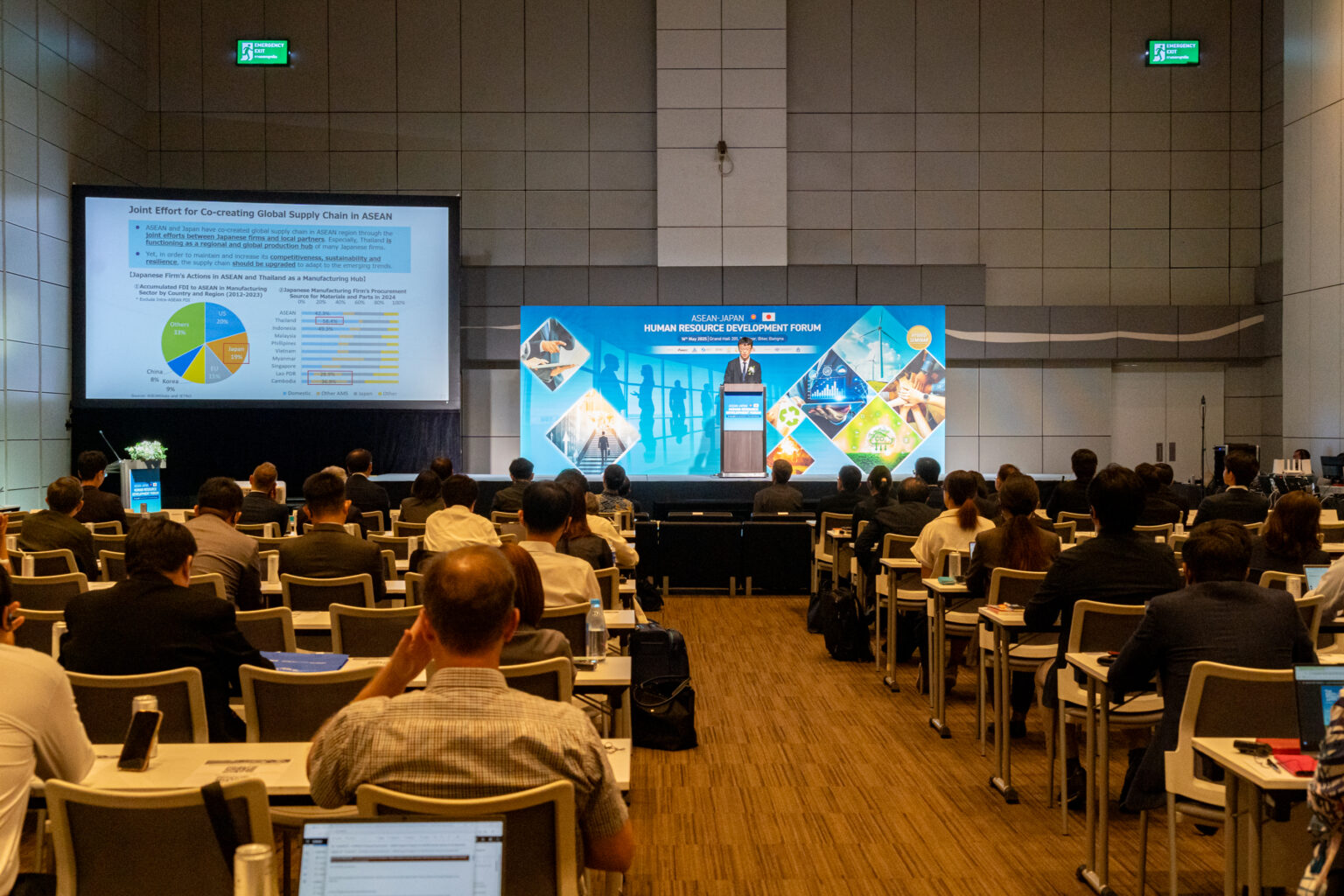
In the opening remarks, Mr. Kuroda Jun, President of JETRO Bangkok, underlined the importance of a supply chain-wide approach in response to changes in global situations. Ms. Sudhasinee Smitra, Senior Executive Investment Advisor of the Thailand Board of Investment (BOI), highlights the success of the "KOSEN Program," which is modeled after Japan's technical college education, and states that human resource investment is the foundation of economic growth.
Mr. Fujioka, Chief Representative of AMEICC Secretariat, stated in his keynote speech that Japan's investment in the ASEAN manufacturing sector is the second-largest after the United States, and that Japanese companies in Thailand have a local procurement rate of approximately 60%, which is outstanding. Taking into account the tariff competition between the U.S. and China, as well as the trend of decarbonization, he called for "strengthening the supply chain and gradual measures for energy conservation and renewable energy" to enhance competitiveness and sustainability.
Mr. Fujioka introduced the “ASEAN Support Program for GX/DX Human Resource Development Training Program,” which is being implemented by AMEICC and AOTS as part of the Japanese government's support measures. He emphasized that in the future, collaboration with local educational and training institutions at the center of the ecosystem will be crucial for advancing human resource development across the entire supply chain.
Mr. Thavorn Chalassathien, Vice Chairman of the Federation of Thai Industries (FTI), emphasized the importance of People Transformation (PX). While introducing initiatives by Thailand's National Science and Technology Development Agency (NSTDA) as a concrete government measure, he argued that "lean manufacturing is the starting point" for the relationship between lean, GX, and DX, and that phased process improvements result in sustained competitiveness.
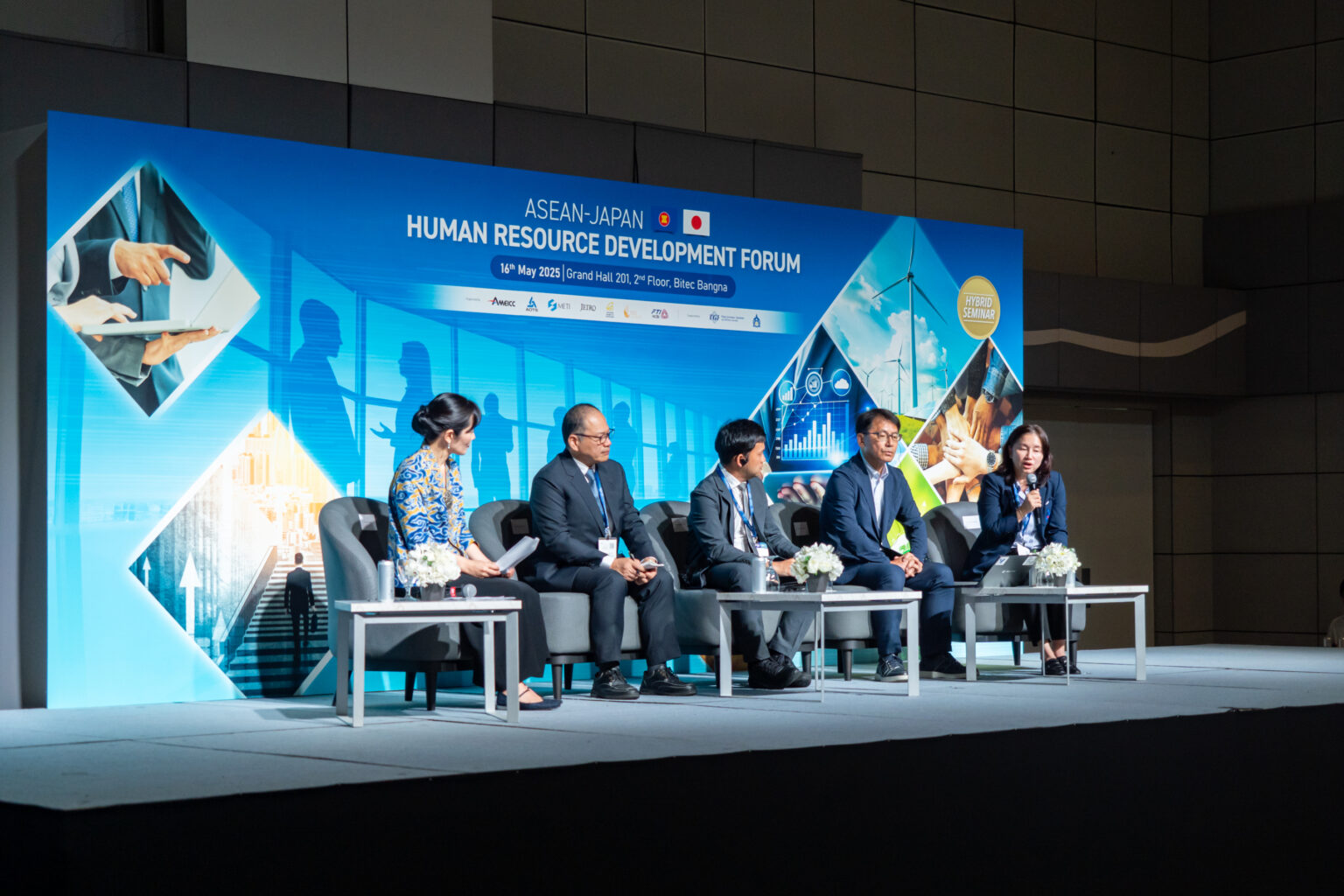
The session focused on actual activities and outcomes resulting from the ASEAN Support Program for GX/DX Human Resource Development Training Program. Mr. Richard Yim, CEO of Cambodia-Japan Digitalized Manufacturing Centre (CJDM), pointed out that "it is important to develop young, ready-to-work professionals on the site." Mr. Chalermrat Sinborisut, Managing Director of Sriborisuth Forging Technology Co., Ltd., a Thai automobile parts manufacturer, shared a case study on developing an operation to reduce power by up to 60% after completing AMEICC-certified training.
Information was shared about the benefits and impact in the workplace from the ASEAN Support Program for GX/DX Human Resource Development Training Program, supported by AOTS. Prof. Dr. Muhamad Insanu, Director of Student Affairs at Institut Teknologi Bandung, highlighted that “human resources who can serve as a bridge between the academic sector and industry are essential.” Mr. Yokoi Masahiro, General Manager of DENSO INTERNATIONAL ASIA CO., LTD, described the personnel development training program as a starting point for supporting on-site improvements and empowering trained personnel to serve as trainers, driving operations on-site independently.
AMEICC and AOTS are committed to strengthening human connections between Japan and ASEAN. This will be achieved through practical support and human resource development, ultimately reinforcing the supply chain and fostering long-term growth.
* For the full press release on the "Japan-ASEAN Human Resource Development Forum", Click Here (Japanese)
 OPEN CALL
 TRAINING PROGRAM
 SITE VISIT